
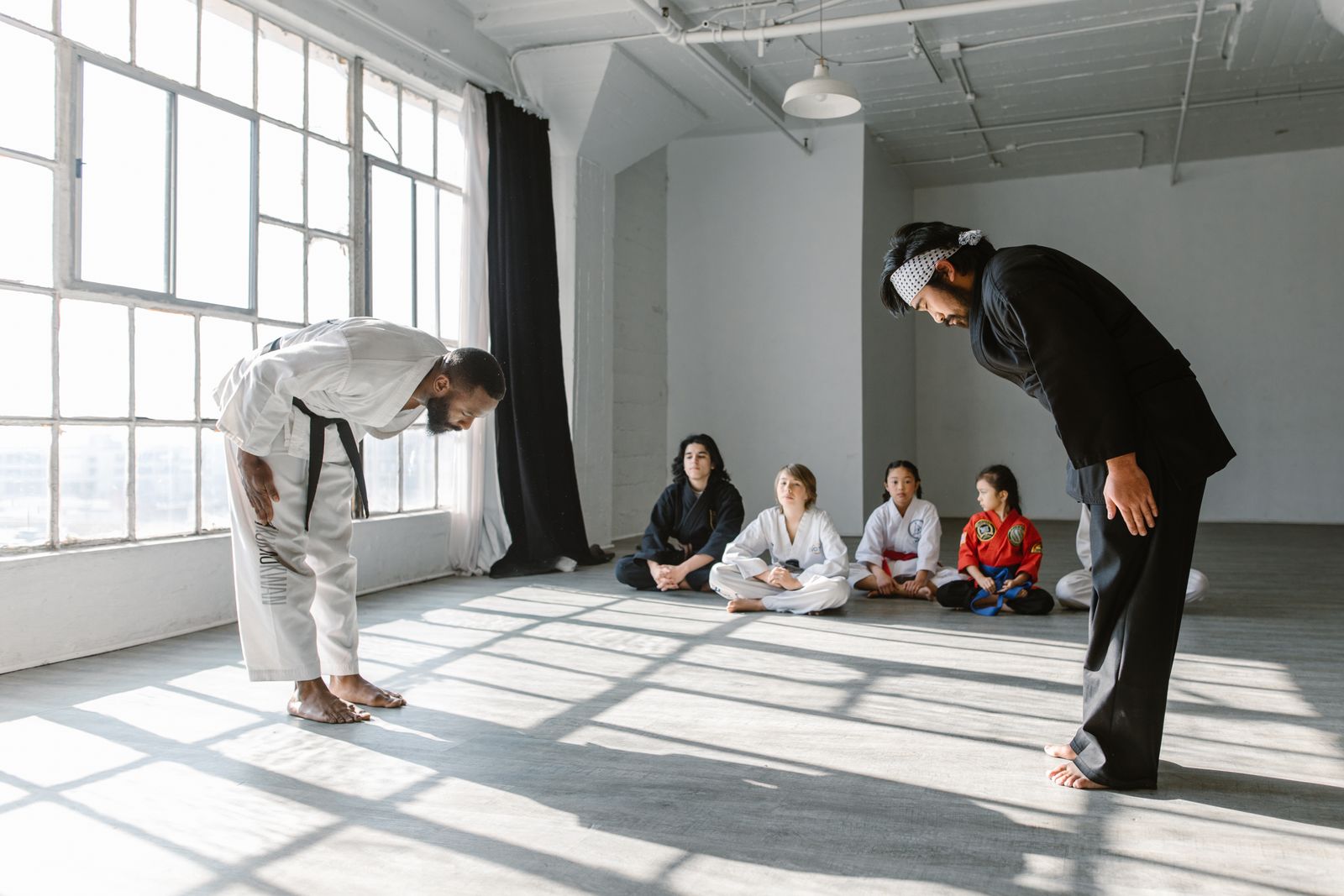
What is Sabaki in Ashihara Karate? A guide for parents and athletes
The principle that unites defence and offence — explained clearly, with examples from training in Pitești.
If you have heard of Ashihara Karate, you have almost certainly heard of Sabaki. The word appears on logos, tournament names and instructors’ explanations. But what does it mean, concretely, for a child in Pitești stepping onto the tatami for the first time?
Sabaki is hard to translate from Japanese into a single word. Broadly, it refers to controlled movement — preparation for what comes next. Kancho Hideyuki Ashihara used the term to define the essence of his style: leave the line of attack, reach an advantageous position (often the opponent’s “blind spot”), and answer with a coherent counter. Defence and offence are no longer two separate moments. They become one flow.
The four circular movements
In classic explanations of the style, Sabaki answers a frontal attack with one of four fundamental movements: outside-left or outside-right, slightly forward or slightly back. In each case, the defender tends to reach the attacker’s flank or back. That limits exposure to frontal strikes and creates a blind spot — a zone from which you can counter with punch and kick combinations.
Distance — short, medium or long — does not change the strategy: leave the line, control the angle, finish. That is why Ashihara insists on awareness of three distance types (ma-ai) and the Sabaki that fits each. An athlete who understands distance hits empty air less often and puts themselves in danger less often.
Why Sabaki suits children
Many parents fear that full-contact karate means only impact. In our dojo, Sabaki is taught progressively with a safety focus. For younger kids it starts as orientation games: “get out of the ball’s path,” “rotate around your partner,” “find your classmate’s back.” Only later come blocks, strikes and combinations. The child learns to move intelligently before learning to hit hard.
Benefits show up in daily life. Coordination improves. Attention grows because you must read a partner’s intention. Confidence appears when you discover you can avoid a situation without panic. Discipline comes from clean repetition of the same principles, week after week.
Sabaki is not “running away.” It is control. You leave the line so you can answer, not so you abandon the exchange. For teenagers the difference matters: in controlled kumite, the one who only retreats loses initiative; the one who pivots and closes the angle sets the pace.
How we train Sabaki in Pitești
A typical class includes warm-up, kihon (stances, strikes, blocks), Sabaki angle drills, combinations and, at the right level, light or controlled-contact kumite. We correct small details: where the weight sits on the foot, how the hip turns, whether the eyes stay on the partner. Those details separate a “pretty” move from a useful one.
Ashihara kata are designed to train exactly these patterns. Unlike some more ceremonial traditional forms, Sabaki-related kata are often presented as applicable combination models — from beginner level to more advanced forms. We do not claim to teach a curriculum identical to one specific world organisation; we teach the style’s principles pedagogically, adapted to our club and age groups in Pitești.
What the style’s sources say
On Ashihara organisation websites you will find recurring ideas: Sabaki as the union of defence and offence; the importance of the blind spot; circular movement; rationality in becoming stronger. There are also formulations about “hitting without being hit” and developing body together with spirit. We use them as an educational compass — not as marketing slogans.
For parents, the practical summary is this: Sabaki teaches children to think movement. We do not cultivate free aggression. We cultivate attention, timing, respect for partners and the ability to stay calm under pressure. In a world where many kids live on screens, a dojo that trains body and decision-making together is a rare resource.
If you want to see Sabaki in action, book a trial class. In one hour you will understand more than from any article — and your child will feel whether the atmosphere fits.