
Hideyuki Ashihara and the birth of a practical karate
From legend to a rational system: who the founder was and why his style still matters for kids today.
Hideyuki Ashihara (1944–1995) founded the style that bears his name. Born on 5 December 1944 and raised in Japan, he became a legendary figure of modern karate — sometimes linked in popular culture to an image of a fearless fighter. For our club, myth is not the point. Method is: a karate designed to be practical, rational and accessible to people who want serious training.
From Kyokushin to an independent path
Ashihara trained in the full-contact tradition, with roots in Kyokushin, and developed his own approach centred on Sabaki — circular movement, angle, distance control. In September 1980 he opened an independent path, founding the organisation known as the New International Karate Organisation (NIKO) – Ashihara Karate Kaikan, based in Matsuyama. He took the title Kancho (style head) and began systematising a curriculum that combined effectiveness with the chance for ordinary people to enjoy training.
Historical sources and official school sites emphasise two aims that remain current: continuing rational improvement (“be strong in mind and body together”) and the idea that anyone can challenge karate and enjoy it. There is also a strong formulation about spirit: if you do not become mentally strong, you cannot truly carry kindness and care for others. For a children’s dojo in Pitești, that is an excellent educational compass.
Books, video and worldwide spread
In the 1980s, Kancho Ashihara published instructional materials in Japanese and English — including volumes such as Fighting Karate and More Fighting Karate — and produced instructional videos. These helped the style spread beyond Japan. Over decades, Ashihara reached multiple continents, and organisations bearing the style’s name evolved, diversified and sometimes split into spin-offs — a common pattern in modern martial arts.
We should be honest with families in Pitești: there are several international organisations linked to Ashihara (with different headquarters and networks). Our club teaches Ashihara Karate as a style and method — Sabaki, practical technique, discipline — without claiming exclusive affiliation to one world federation unless that is stated explicitly on the site. Transparency builds trust.
The legacy after 1995
Kancho Hideyuki Ashihara died on 24 April 1995 after a serious illness. According to materials from the school in Japan, his son Hidenori Ashihara took leadership at a very young age and continued spreading the style. Today Ashihara Kaikan speaks of dozens and hundreds of branches in Japan and worldwide, of courses for youth, adults, women and self-defence, and of transmitting Sabaki across generations (“Sabaki Souden”).
Among students and people formed in Ashihara’s orbit are names who later influenced other styles or combat sports — a sign that the method was taken seriously by high-level fighters. For us, relevance is not a celebrity list. Relevance is that the style was designed to work in real situations, including against multiple attackers, and to remain trainable for people who are not professionals.
What this means for children in Pitești
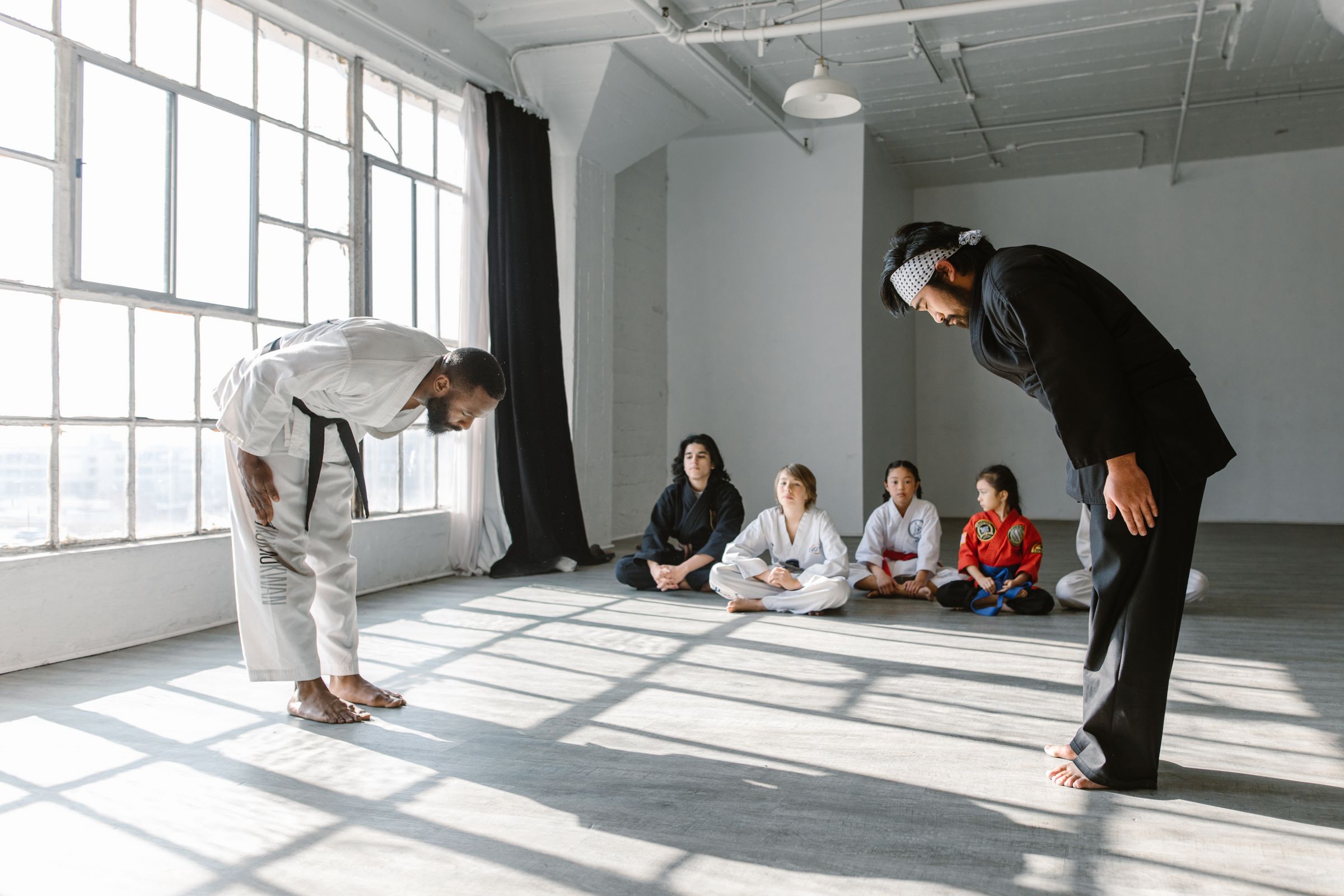
When we teach Ashihara at the club, we do not recreate 1980s Japan. We adapt the principles: Sabaki explained for each age, dojo etiquette, graded progress, safety in kumite, respect for partners. Children learn that strength without control is noise; that angle and timing often beat blind force; that bowing and discipline are not formalities, but part of technique.
The style’s history also gives them a narrative thread: there is a founder, a clear idea, a worldwide community still training the same principles. That helps them feel they are part of something larger than one hour of sport a week.
If you want to learn more, read our Ashihara & Sabaki page — or come straight to a trial class. History is best understood on the tatami, where theory becomes movement.